
About Equine Degenerative Myeloencephalopathy (EDM)
Tuesday, November 21, 2023 | Press Release
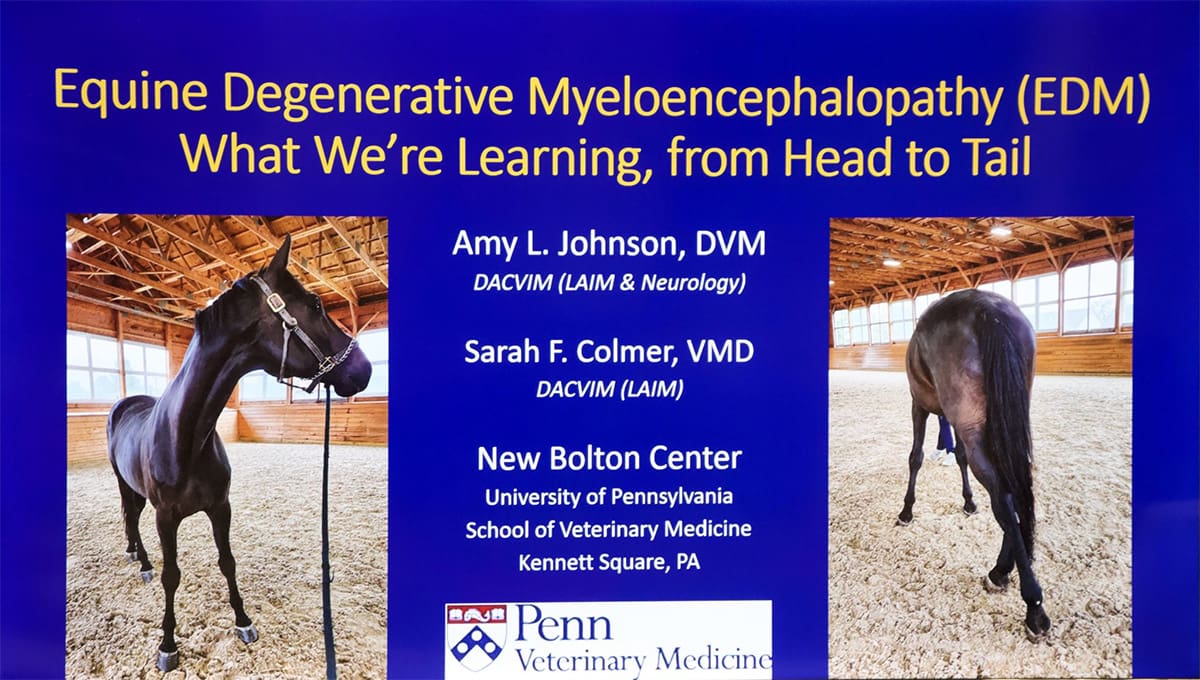
Once thought to be quite rare, Equine Degenerative Myeloencephalopathy (EDM) is a neurodegenerative disorder that has become increasingly recognized. As time goes on and continues to be difficult to identify as its clinical signs often resemble other neurologic disorders such as cervical vertebral compressive myelopathy, equine protozoal myeloencephalitis (EPM), and equine herpesvirus 1 myeloencephalopathy (EHV 1).
About Dr. Amy Johnson
Dr. Amy Johnson is a Diplomate of the American College of Veterinary Internal Medicine – Large Animal & Neurology, a Marilyn M. Simpson Associate Professor of Equine Medicine at the University of Pennsylvania School of Veterinary Medicine – New Bolton Center, and the Section Chief of Internal Medicine & Ophthalmology at New Bolton as well.
A leader in the field of neurology, Dr. Johnson partnered with her neurology research fellow, Dr. Sarah Colmer, Diplomate American College of Veterinary Internal Medicine – Large Animal, to provide guests with invaluable insight as to what is being learned about EDM from head to tail.
Clinical Signs
Dr. Johnson explained that EDM results in abnormalities of specific neurons in the brainstem and spinal cord and can cause a whole host of behavioral and neurologic issues. These clinical signs typically appear in affected horses before the age of two, but can often be hard to recognize if the horse presents only with mild symptoms. While research on EDM is ongoing, currently neither an official antemortem diagnosis nor effective treatment are available.
Predisposed to the Disease
Horses with EDM are genetically predisposed to the disease, but an environmental trigger in the form of Vitamin E deficiency is required for onset of clinical symptoms, which include lack of coordination, gait abnormalities, and proprioceptive deficits (unsure where to place their feet). In the living horse, EDM is considered a “diagnosis of exclusion,” meaning that it has no accurate diagnostic test and other possible causes of the horse’s neurologic signs must be ruled out through appropriate diagnostic testing before backing into a diagnosis of EDM.
Defining an Accurate Diagnosis
Finding a more accurate means of diagnosis in the living horse is an active area of research. For a period of time, a biomarker test for phosphorylated neurofilament heavy subunit (pNF-H) was available at the University of California- Davis. However, many horses with EDM did not have increased pNF-H concentrations, limiting its utility. Research at New Bolton Center suggests that biopsy of the tailhead muscle can help lend support to a diagnosis of EDM; this muscle shows damage after a period of vitamin E deficiency, which is a known risk factor for EDM. Postmortem examination of the brain and spinal cord is still required for a definitive diagnosis of EDM.
Dressage at Devon Educational Program
For nearly 50 years, Dressage at Devon (DaD) has offered not only world-class competition but also a vast array of educational opportunities for competitors and spectators alike.
DaD has recognized the importance of education from the onset and has made education one of its core initiatives, bringing all who attend countless opportunities to learn from the best in the industry year after year.
The 2023 edition of Dressage at Devon presented by Kingsview Partners welcomed the New Bolton Center’s Dr. Amy Johnson, Dr. Tamara Dobbie, and Dr. Katrin Hinrichs, as well as Dr. Hillary Clayton and Shawna Karrasch. This impressive group of industry leading experts provided invaluable insight on Equine Degenerative Myeloencephalopathy (EDM), Intracytoplasmic Sperm Injection (ICSI), Biomechanics, and Positive Reinforcement, respectively.


Latest News
LOOKING BACK
USDF president George Williams congratulates Steffen Peters and Jen and Bruce Hlavacek owners of [...]

Christine Ekstrand from Santa Monica, Calif was accompanied by three of her seven children [...]
Featured Real Estate





Featured Horse