Training Your Eye To Evaluate The Horse’s Biomechanics with Dr. Hilary Clayton
Tuesday, November 21, 2023 | Press Release
A horse’s conformation, how they carry themselves, the way they are ridden, and the tack they are ridden in all contribute to their ability to perform. Combining physics and physiology, the study of equine biomechanics focuses on how both components impact the performance of a horse.
The Degree of Spine Movement Depends on the Gait
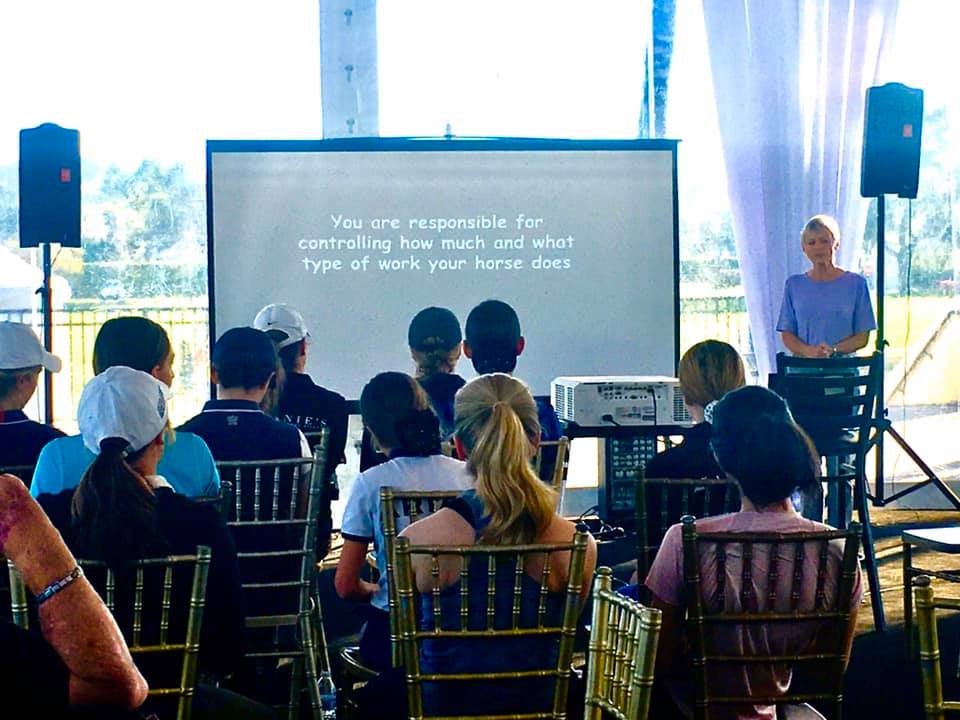
Dressage at Devon welcomed Dr. Hilary Clayton, BVMS, PhD, Dipl. ACVSMR, FRCVS, an industry leading expert in the field of equine biomechanics, to speak at this year’s competition. Setting a foundation upon which to build, Dr. Clayton gave a general overview of the vertebral structure of a horse. Dr. Clayton explained how each intervertebral joint in a horse’s spine only has a small degree of mobility individually, but collectively, allow for considerable movement throughout the neck and back.
The degree of movement required varies depending on the gait. Of the three gaits, the canter requires the most flexion and extension, and therefore necessitates the greatest degree of stability in the back.
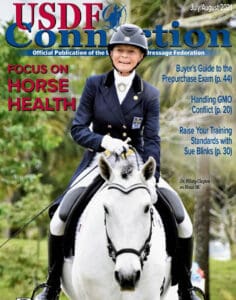
Dr. Hilary Clayton cover of USDF Magazine
Back Movement In a Horse Is a Result of Physics
Speaking into the physics component, Dr. Clayton explained that the back movement we see in a horse as they perform is a result of physics – inertia, gravity, and propulsive forces coming from the hind legs. Dr. Clayton explained that the horse’s back must actually remain stable to support the horse’s weight and transmit the propulsive forces from the limbs. Thus, in order to control the movement of the spine, the back muscles must be supple.
Using the analogy of a beam, Dr. Clayton described how the weight of the horse’s organs in combination with the weight of the tack and the rider can result in the hollowing of the beam (back) in the middle, thereby causing the vertebra to compress in what is known as kissing spines.
Just as a hollow back brings the vertebra closer together, so too does a round back increase space between the spinous processes. Dr. Clayton thus concludes that regardless of discipline or level of competition it is invaluable for your horse to learn to work with a round topline.
About Dr. Hilary Clayton
A veterinarian, researcher and horsewoman, Dr. Clayton has performed innovative research for over 40 years in the areas of locomotor biomechanics, lameness, rehabilitation, conditioning programs for equine athletes, and the interaction between rider, tack, and horse.
Her work has been published in over 200 articles as well as seven books. Dr. Clayton served as the Mary Anne McPhail Dressage Chair in Equine Sports Medicine at Michigan State University’s College of Veterinary Medicine from 1997 until she retired from academia in 2014.
Continuing to collaborate with colleagues at universities around the world, Clayton’s research is ongoing. A charter diplomate and past president of the American College of Veterinary Sports Medicine and Rehabilitation, Dr. Clayton is also an Honorary Fellow of the International Society for Equitation Science and has been inducted into the International Equine Veterinarians Hall of Fame, the Midwest Dressage Association Hall of Fame, and the Saskatoon Sports Hall of Fame.
A passionate horsewoman and competitive rider, Clayton has competed in many equestrian sports, most recently focusing on dressage in which she trains through the Grand Prix level and has earned U.S. Dressage Federation bronze, silver, and gold medals.
Featured Community


Save the Date
The STRIDE Dressage Club of Ocala, established in 1989, serves as the backbone for [...]
Latest News